
New Moon to Full Moon: Rituals for Manifestation (2026)
An honest guide to moon rituals in 2026: a 10-minute new moon ritual and a full moon release ritual you can do tonight, the next new moon date, every moon date through December, and what the research actually says.
Moon rituals have become one of the most visible spiritual practices of the past few years: new moon intention journals, full moon release ceremonies, entire calendars built around lunar phases. Before getting into how to practice this well, it is worth being honest about something most moon-ritual content skips: decades of research have found no reliable link between the lunar cycle and human mood, behaviour or biology. That is a real finding, not a minor caveat. But it does not make the ritual pointless. It means the reason it works is not the one usually given, and understanding the actual reason, a well-evidenced psychological mechanism called the fresh-start effect, makes a new moon ritual or a full moon ritual more useful, not less.
This guide gives you the ritual first and the science second: the next new moon date, a step-by-step new moon ritual for manifestation, a short full moon release ritual, every October to December 2026 date in your time zone, and then the honest version of why any of it helps.
Next new moon: Saturday 10 October 2026
The next new moon is on Saturday 10 October 2026 at 15:50 UTC (18:50 in Riyadh and Doha, 11:50 am in New York). If you are reading this before then, you have a clean landmark coming this weekend. If you are reading this after, the following new moon is Monday 9 November, and the full dates table is just below.
In this guide
- The 10-minute new moon ritual, step by step
- The full moon release ritual, step by step
- Moon dates: October, November and December 2026
- What the research actually says about the moon and human behaviour
- So why does the ritual still work? The fresh-start effect
- The new moon: setting an intention with more precision
- The full moon: what a release ritual is actually doing
- A simple monthly practice
- Holding the ritual and the science at the same time
- Frequently asked questions
The 10-Minute New Moon Ritual, Step by Step
This is a new moon ritual for beginners and for people who have done fifty of them. It needs a pen, something to write on, and ten minutes within a day or two of the new moon. Candles, crystals and a bath are optional; they help some people sit down and do it, and that is their only job.
- 1Clear the space, and the last cycle. — Two minutes. Put your phone face down, light a candle if you use one, and write one line about the month that just ended: what you tried, what happened. This is the "line in the sand" the fresh-start effect runs on. You are closing the previous version of yourself before opening the next.
- 2Choose one intention, not five. — One. Phrase it as something you are moving toward, not something you are escaping: "building a consistent morning routine," not "stop being so scattered." Vague wishes dilute the effect; a single specific intention concentrates it.
- 3Write it as a present-tense scene. — Three minutes. Describe one ordinary moment inside the intention as if it is already happening: where you are, what you are doing, how it feels. This borrows the scripting method from the law of assumption, and it works for the same reason there: specific, felt detail is what the mind can rehearse.
- 4Attach one action with a 48-hour deadline. — Write the single concrete first step you will take within two days, and when. Research on fresh-start motivation shows the boost is real but fades within days if it is not converted into an actual first move while it is active. This step is the whole difference between a ritual and a wish.
- 5Say it out loud, once. — Read the intention and the action aloud. It feels awkward and it matters: speaking it makes it harder to quietly abandon, and it marks the moment.
- 6Close and schedule the review. — Date the page, write the next full moon date at the bottom (it is in the table below), and put a five-minute reminder in your calendar for that day. Blow out the candle. Done.
The Full Moon Release Ritual, Step by Step
Roughly two weeks after the new moon, the full moon ritual is traditionally a release point rather than a starting point. Functionally it is a scheduled midpoint review for the intention you set. Five minutes is enough.
- 1Reread the new moon page. — Not to judge it. Just to remember exactly what you wrote and what the 48-hour action was.
- 2Write what shifted and what did not. — Two or three honest lines. Did you take the first action? What got in the way? What surprised you?
- 3Name one thing to release. — A habit, a comparison you keep making, an unrealistic version of the goal, or the goal itself if it was wrong. Write it as a single sentence beginning "I am putting down…" Some people burn the paper; tearing it works just as well.
- 4Revise the intention, if it needs it. — Changing course at the full moon is the practice working, not failing. Rewrite the intention in one line for the second half of the cycle, and note the next new moon date.
Moon Dates: October, November and December 2026
All times are the astronomical instant of the phase. For ritual purposes, the day of the phase and the day after are both fine; you are using the moon as a landmark, not a deadline. Times in Riyadh and Doha are UTC+3.
| Phase | Date | UTC | Riyadh / Doha | Use it for |
|---|---|---|---|---|
| New Moon | Sat 10 October 2026 | 15:50 UTC | 18:50 Riyadh/Doha | Set your Q4 intention |
| Full Moon (Hunter's Moon) | Mon 26 October 2026 | 04:13 UTC | 07:13 Riyadh/Doha (evening of Sun 25 Oct in the Americas) | First review and release |
| New Moon | Mon 9 November 2026 | 07:02 UTC | 10:02 Riyadh/Doha | Reset before the holidays |
| Full Moon (Beaver Moon) | Tue 24 November 2026 | 14:55 UTC | 17:55 Riyadh/Doha | Release what the year no longer needs |
| New Moon | Wed 9 December 2026 | 00:52 UTC | 03:52 Riyadh/Doha (evening of Tue 8 Dec in the Americas) | The last intention of the year |
| Full Moon (Cold Moon) | Thu 24 December 2026 | 01:29 UTC | 04:29 Riyadh/Doha (evening of Wed 23 Dec in the Americas) | Close out 2026: reflect, release, and rest |
Note the three dates that fall very early in the morning in the Gulf (26 October, 9 December, 24 December): if you prefer to do the ritual the evening before, that is the same night as the phase in the Americas and close enough everywhere.
What the Research Actually Says About the Moon and Human Behaviour
The belief that the full moon affects human behaviour, increased hospital admissions, erratic mood, disrupted sleep, is old enough to have given English the word "lunatic." It has also been tested extensively. Literature reviews and meta-analyses spanning decades of research have consistently found no reliable correlation between lunar phase and human biology or behaviour, including the specific claims about crime, sleep and psychiatric admissions that circulate most often. Where people do perceive a pattern, researchers point to illusory correlation, a well-documented cognitive bias where a few memorable, moon-adjacent bad nights get remembered and reinforced while the far more numerous ordinary full moons that came and went unremarkably simply do not register.
It is worth being precise here rather than dismissive: the lunar cycle does measurably affect some animal species, particularly around reproduction in marine life, through mechanisms tied to moonlight and tides. Humans, evolutionarily removed from most of those pressures and living under artificial light, do not show the same reliable pattern, which is exactly why it is honest to separate the animal research from the human behaviour claims when they get lumped together in wellness content.
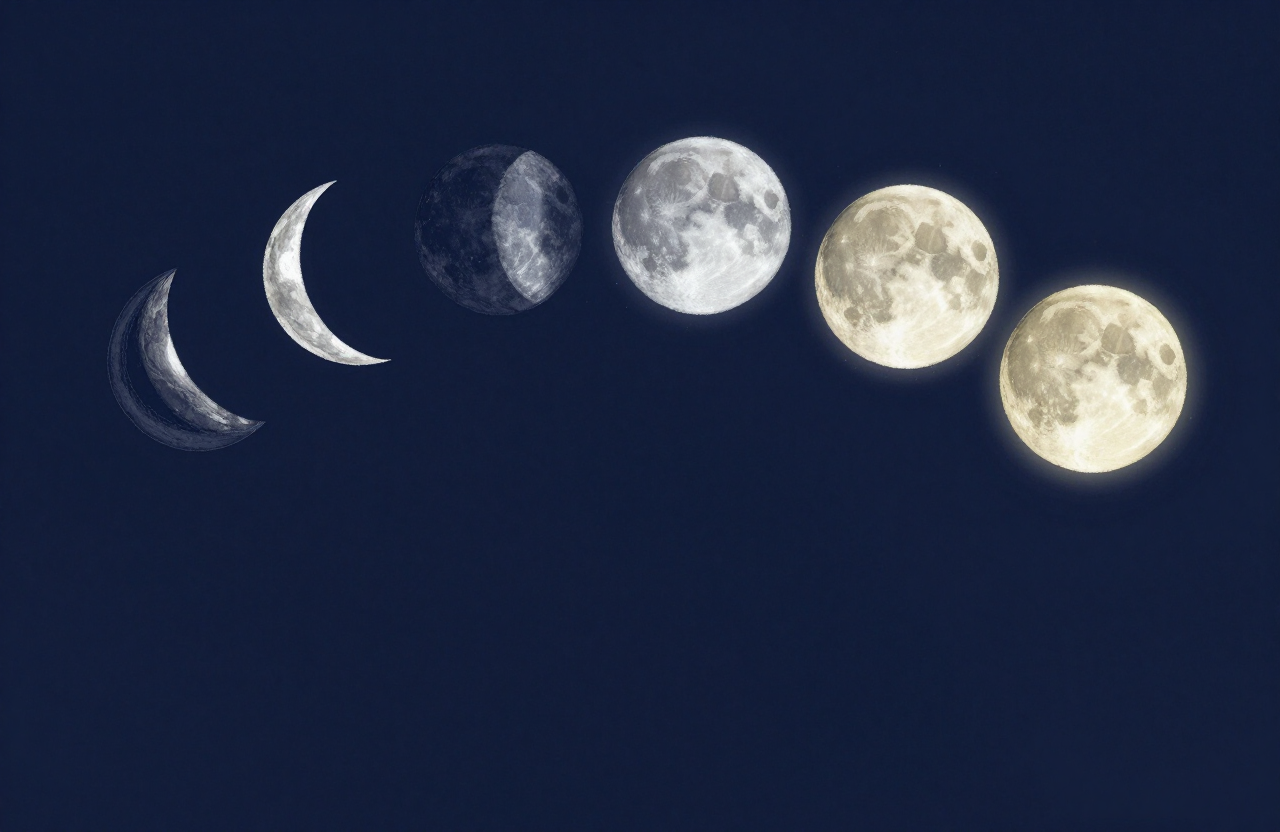
The lunar cycle runs a reliable 29.5 days — a rhythm the ritual borrows even when the biology claim doesn't hold up.
So Why Does the Ritual Still Work? The Fresh-Start Effect
This is where the science gets interesting rather than deflating. Behavioural researcher Katherine Milkman's well-documented "fresh start effect" found that people are significantly more likely to pursue goals and commit to change right after a temporal landmark: a new week, a new month, a birthday, a holiday. Her research tracked spikes in gym visits, diet-related searches and goal commitments specifically following these markers, and proposed a clear mechanism: landmarks create a mental line between a "previous version" of yourself and a fresh one, making it easier to set past setbacks aside and take a clean, motivated run at a goal.
A new moon, arriving reliably every 29.5 days, functions as exactly this kind of temporal landmark, regardless of whether the moon itself is doing anything to your biology. A new moon ritual works for the same psychological reason a Monday or a birthday works, with a built-in monthly rhythm a birthday cannot offer. This is not a consolation-prize version of the practice; it is a real, well-evidenced mechanism, just a different one than the marketing usually claims.

The new moon works like a Monday or a birthday — a temporal landmark that gives your motivation a clean place to restart.
The New Moon: Setting an Intention With More Precision
Given that the value here is a fresh-start landmark rather than a literal lunar force, a new moon ritual for manifestation works best when the intention itself is specific rather than a vague wish. One intention, phrased toward rather than away, with one concrete first action inside 48 hours, because the fresh-start boost is real but time-limited. The step-by-step above is built entirely around those three rules.
The Full Moon: What a Release Ritual Is Actually Doing
The full moon, roughly two weeks after the new moon, is traditionally treated as a release point rather than a starting point: a structured moment to name what you are ready to let go of. Functionally, a full moon ritual for manifestation works as a scheduled reflection checkpoint, giving your new moon intention a built-in midpoint review rather than leaving it to run unexamined until you happen to think of it again. Write what is no longer serving the intention you set, whether that is a specific habit, a comparison you keep making, or an unrealistic version of the goal that needs adjusting rather than abandoning.

The full moon ritual is a scheduled reflection checkpoint — a built-in midpoint review for the intention you set two weeks earlier.
A Simple Monthly Practice
New moon: ten minutes, one written intention, one concrete action with a 48-hour deadline. Full moon: five minutes, a short review of what has shifted and what is not working, with permission to revise the original intention rather than treating a change of course as failure. That is the entire practice. The value comes from the reliable rhythm and the specificity of what you write, not from candles, crystals or any particular ceremony, though there is nothing wrong with adding those if they help you actually sit down and do it.
Holding the Ritual and the Science at the Same Time
None of this requires choosing between finding the practice meaningful and being accurate about why it works. Plenty of useful rituals, New Year's resolutions, birthday reflections, Sunday planning, do not depend on any external force doing something to you; they depend on a reliable, recurring landmark giving your own motivation a clean place to restart. The moon, arriving every 29.5 days whether or not it is affecting your biology, is simply a particularly elegant version of that same reliable landmark. If the symbolism and language of moon ritual help you sit down and actually do the reflection, there is no cost to keeping them; they are doing real psychological work as a consistent cue and container for the practice.

The symbolism of moon ritual does real psychological work as a consistent cue and container — just not the work the marketing usually claims.
Frequently Asked Questions
When is the next new moon?
Saturday 10 October 2026 at 15:50 UTC (18:50 Riyadh/Doha). After that: Monday 9 November (07:02 UTC) and Wednesday 9 December (00:52 UTC, which is the evening of 8 December in the Americas). The full table above has every date through December.
When is the next full moon?
Monday 26 October 2026 at 04:13 UTC, the Hunter's Moon (the evening of Sunday 25 October in the Americas). Then Tuesday 24 November (Beaver Moon, 14:55 UTC) and Thursday 24 December (Cold Moon, 01:29 UTC).
What is the difference between a new moon ritual and a full moon ritual?
A new moon ritual is for setting one intention and attaching a first action; a full moon ritual, about two weeks later, is a scheduled checkpoint to review progress and release what is not working. Together they form a built-in monthly review cycle.
How do I do a full moon ritual for beginners?
Reread what you wrote at the new moon, write two honest lines on what shifted, name one thing to put down, and revise the intention if it needs it. Five minutes. The four steps above are the full version; candles, a bath or crystals are optional atmosphere.
Do I need candles or crystals for a new moon ritual?
No. Nothing in the evidence depends on them. They can help as a cue that tells your brain "this is the moment," the same way a specific mug signals coffee time, so keep them if they get you to the page and skip them if they do not.
Does the full moon actually affect mood or sleep?
Decades of research have found no reliable link between lunar phase and human mood, sleep or behaviour. The perception of a pattern is well explained by illusory correlation: memorable moon-adjacent bad nights get noticed and remembered while unremarkable ones do not.
If the moon doesn't scientifically affect manifestation, why do a moon ritual at all?
Because of the fresh-start effect, a well-documented psychological mechanism: recurring temporal landmarks like a new moon make it easier to set past setbacks aside and commit to a goal, regardless of any lunar influence on biology.
How do I write a new moon intention that actually works?
One specific, forward-moving intention rather than several vague wishes, and one concrete action you will take within 48 hours. The motivational boost is real but fades quickly if it is not converted into a first step.
Do I need to track exact moon phases for the ritual to work?
Not precisely. The psychological benefit comes from a reliable, recurring landmark, not from timing your journaling to the exact minute. The day of the phase or the day after both work; a rough biweekly check-in tied loosely to the cycle captures the same effect.
Conclusion
The moon is not pulling your intentions into reality, and it is worth being honest about that rather than borrowing a claim the evidence does not support. What it offers instead is something equally useful and considerably less mysterious: a reliable, recurring landmark that makes it easier to start again, on schedule, every 29.5 days. The next one is on 10 October. Ten minutes, one intention, one action, and a review two weeks later is more than enough to build a practice around.
For more reflective, evidence-aware practices for setting and keeping intentions, keep exploring the Zen Pillar at healzenglow.com/zen.
References
- [1] Dai, H., Milkman, K. L., & Riis, J. (2014). The fresh start effect: Temporal landmarks motivate aspirational behavior. Management Science, 60(10), 2563–2582.
- [2] Rotton, J., & Kelly, I. W. (1985). Much ado about the full moon: A meta-analysis of lunar-lunacy research. Psychological Bulletin, 97(2), 286–306; and subsequent reviews in psychology and chronobiology.
- [3] Research on illusory correlation as the cognitive mechanism behind persistent belief in unsupported behavioural patterns.
- [4] Moon phase times: calendar-12.com/moon_phases/2026 and theskylive.com, cross-checked October 2026.